-
Representative sample
Send production sheet from the intended mill, not a substitute gauge. Cups and trays need the same rim, stacking lugs and printed register the plant will run. Food packaging samples should state the intended fill, storage temperature and any cleanability demand.
-
Demonstration
Ask the factory to form on the quoted forming area with the proposed cavity count. Record heater settings, cycle time, start-up scrap and wall-thickness maps at agreed points. A video of a different cup is not this demonstration.
-
Acceptance record
Write how rim geometry, wall-thickness distribution and stack quality will be measured after conditioning. FAT and SAT remain contract language between buyer and supplier; this site does not sign those records.
Independent machinery sourcing · Evidence
thermoforming machine
Thermoforming Machine Sourcing is an independent sourcing partner for a thermoforming machine that heats sheet, forms it in a tool, then trims and stacks cups, trays or lids. We help equipment buyers collect comparable factory quotations. We do not own a forming hall, hold finished-machine inventory, or act as a brand-appointed reseller of any OEM. Blow molding, extrusion and injection molding sit outside this RFQ unless you add them as a separate line. Share sheet polymer, gauge, cavity layout, quantity and destination to request factory quotes.
Request Factory Quotes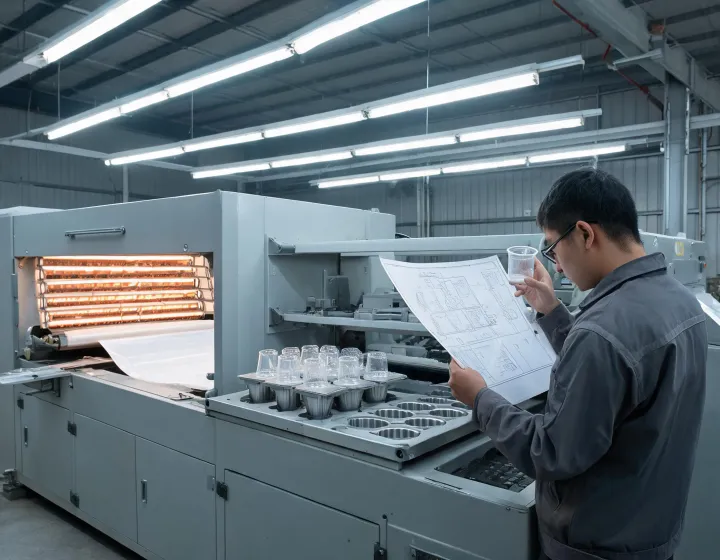
Duty and operating envelope
- Material entering the machine
- Name the polymer or multilayer structure (PET, PP, PS or a barrier laminate), roll width, sheet gauge and whether the web is printed. Food-contact sheets need hygiene and cleaning notes separate from the machine leaflet. Throughput is only comparable when that feedstock is frozen.
- Required output
- State accepted parts per hour at a named cavity layout and sheet gauge, not cycle frequency alone. ILLIG RDM-class leaflets publish forming area, forming height and closing force in kN; those figures constrain tooling, they do not prove your cup will run. See why cavity layout determines useful capacity.
- Duty cycle
- Record shifts per week, planned SKU changeovers, and whether the same heater and forming station must restart after a tool swap without a second commissioning visit.
Compare procurement cost boundaries
A thermoforming machine price is only one band. Rank factory replies after machine, delivery and site lines use the same Incoterms, the same tool ownership and the same acceptance sample. This desk compares written scopes; it does not publish a percentage saving.
Machine
Heater zones, forming station, closing force, plug assist, in-mold cut or downstream trim, and stacking if the factory includes them. Forming area in mm must match the tool drawing.
Delivery
Crate, inland haul, ocean freight, duties and destination handling to the named US dock. Totals are comparable only after Incoterms appear on each reply.
Site
Footprint, three-phase supply, compressed air demand, cooling water, extraction, installation, training and a first spare-parts kit. These lines often sit outside the machine price.
Trial sequence before ranking thermoforming quotations
Product changeover questions for a thermoforming machine RFQ
Which procurement scope is covered by thermoforming machine?
What changes between products?
Cup diameter, tray footprint, draw depth, printed register and sheet gauge each change the tool, plug assist and trim nest. A family of similar cups may share a station; a jump from shallow lids to deep cups usually needs a new forming tool and a new trim set. State the SKU list with the RFQ.
What must be cleaned or replaced?
Forming inserts, plug assists, trim knives, stacking magazines and any food-contact surfaces that hold residue. Ask who supplies those parts and how long a documented changeover takes on the quoted heater and station. Heater zone maps should be saved with the tool, not only in an operator notebook.
How is the first good output verified?
First-good checks typically include rim dimensions, wall-thickness distribution, print-to-cut register and stack height after a stated conditioning time. Cycle rate from a leaflet is a reference until that first-good record exists for the buyer sheet.
What cavity layout and sheet gauge define accepted parts per hour?
Accepted parts per hour equals cavities that actually form and trim, times cycles that pass inspection, on the named gauge. Web waste between cavities belongs in the material-use comparison. Closing force in kN must be checked against the tool projected area; a large forming area with a light closing force can limit cavity count even when the heater is fast.